
Getting Playdough Out of Carpet: The Preschool Parent’s Nightmare
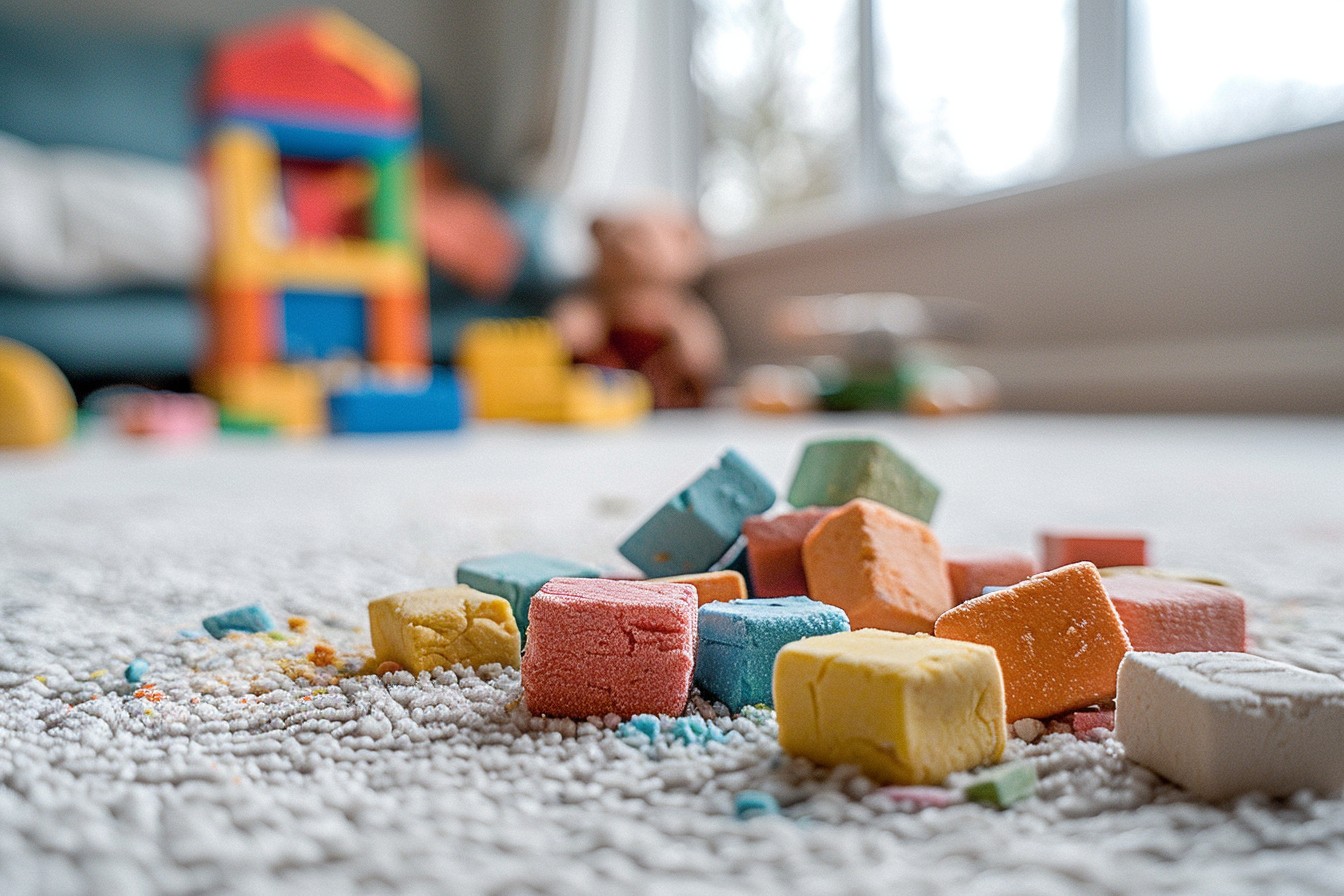
You turned your back for four minutes. That’s all it was. Four minutes to answer a phone call, pour a cup of tea, or simply stare briefly out of the window and remember what silence used to feel like. And in those four minutes, an entire tub of bright yellow playdough has been pressed, with what can only be described as professional commitment, deep into the pile of your living room carpet. Your three-year-old is looking at you with an expression of pure creative satisfaction. The carpet is not. If there is a more universal rite of passage for parents of young children in this country, it hasn’t made itself known yet. The good news is that playdough in carpet, for all its visual drama, is a genuinely recoverable situation. The bad news is that almost every instinct you have about how to approach it is wrong.
Why Playdough Is a Uniquely Tricky Carpet Problem
The Ingredients Work Against You
To understand why playdough behaves the way it does in carpet, it helps to know what it actually is. Shop-bought playdough – the kind that comes in those satisfying little tubs – is primarily flour, water, salt, and a colouring agent, bound together with a small amount of oil or cream of tartar. Homemade versions follow broadly the same recipe with varying ratios. It sounds harmless, and in isolation it largely is. The problem is what each of those components does when it meets carpet fibre under pressure.
The flour and starch content makes playdough sticky when warm and rock-solid when dry, bonding to individual fibres with impressive tenacity. The salt content, if left in place, is mildly hygroscopic – it draws moisture from the air, keeping the residue slightly damp and more adhesive for longer than you’d expect. And the colouring agents – particularly in the vivid primary colours that children inexplicably always reach for first – are frequently strong enough to transfer dye into carpet fibres, leaving a stain that persists long after the bulk material has been removed. It is, in short, engineered by accident to be as difficult as possible.
The Wet vs Dry Dilemma
Here is the central tension of every playdough carpet incident: the material behaves completely differently depending on its moisture content, and your response needs to match its current state rather than the state you wish it were in. Fresh, warm playdough is pliable, sticky, and highly penetrating – press it into a carpet in this state and it works its way between fibres and down toward the backing with enthusiasm. Dried playdough is brittle, crumbly, and relatively easy to break apart mechanically, but it also has a tendency to shed fine particles deep into the pile as it’s disturbed.
Most parents’ instinct is to go at fresh playdough immediately and aggressively, which typically results in it being worked deeper and spread wider. The correct response is considerably more counter-intuitive, and it is the foundation of everything that follows.
The Golden Rule – Let It Dry First
Why Intervening Too Early Makes Everything Worse
This will feel wrong. It will feel irresponsible. You will have a powerful urge to do something, anything, right now. Resist it. Fresh playdough pressed into carpet is at its most mobile, most adhesive, and most penetrating in its current state. Attempting to remove it while it’s still soft – picking at it, scrubbing it, applying water – does not extract the material. It relocates it, drives it deeper, and in the case of water application, activates the starch content and creates something with the approximate carpet-bonding properties of wallpaper paste.
Leave it alone and let it dry completely. Depending on the volume involved and the ambient conditions of your room, this takes anywhere from two to four hours for smaller deposits and potentially longer for what you’d charitably call a “larger creative project.” Use this time productively.
What to Do While You Wait
While the playdough dries, there are a few things you can do that will genuinely help the removal stage. First, if there are any large surface pieces sitting on top of the pile rather than pressed into it, remove them carefully now – lift rather than press, and place them back in the tub, because a preschooler who watches their playdough be thrown away is a problem you don’t need on top of the carpet situation. Second, if you have a fan or can open a window, increase airflow across the affected area. Moving air accelerates drying without adding heat, which is what you want. Do not use a hair dryer or point a radiator at it – heat reactivates the starch and makes the bonded residue harder to break apart cleanly.
Removing Dried Playdough – Step by Step
The Mechanical Removal Stage
Once the playdough has dried to a firm, brittle consistency, you can begin mechanical removal. Start with your fingers, breaking the bulk material apart into smaller pieces and lifting them away from the pile. Work from the outside edges inward and use a lifting motion rather than a dragging one – you’re separating the playdough from the fibre, not pulling the fibre along with it. A stiff-bristled brush or an old toothbrush is useful here for dislodging smaller fragments from between individual carpet fibres.
Vacuum thoroughly after the initial manual removal, using a nozzle attachment rather than the full floor head to give you more precise control over the suction area. You may need to vacuum, brush, and vacuum again in alternating passes to lift the finer crumbled particles that have settled lower in the pile. Take your time with this stage – the more dry material you remove mechanically, the less work the cleaning solution has to do, and the lower your risk of spreading a residual stain.
Treating the Residue
After mechanical removal, you’ll typically have one of two things remaining: a faint shadow where the oils and binders have left a slight greasy mark, or a colour stain from the dye content, or – in the case of enthusiastically applied bright red playdough – both simultaneously. For the oily residue, a small amount of washing-up liquid diluted in cold water, applied sparingly and blotted rather than rubbed, will cut through the binder component effectively. On wool carpets, check your pH – the same rules from our first article apply here, and a wool-safe product is the correct choice regardless of how tired you are and how tempted you are to just use whatever’s nearest.
Colour Staining – The Real Villain
Why Bright Colours Are the Worst Offenders
If playdough were always beige, this would be a much simpler article. It is not beige. It comes in traffic-light red, electric blue, nuclear yellow, and a green that has no business being that green. The dye concentrations used to achieve these colours are significant, and on light-coloured or wool carpets, they will transfer readily into the fibre during the time the playdough is in contact with it. This is particularly true if the playdough was pressed in while warm, which opens the fibre’s surface and makes it more receptive to dye uptake.
Red and purple are the most persistent offenders – they contain dye molecules that bond aggressively to natural fibres and are genuinely resistant to standard cleaning solutions. Blue and green are difficult but more responsive to treatment. Yellow, mercifully, tends to be the most manageable.
Treating Dye Transfer on Different Carpet Types
For synthetic carpets, a diluted solution of washing-up liquid followed by a small amount of rubbing alcohol applied to the stain and blotted thoroughly will lift the majority of playdough dye transfer. Work in stages, blotting between each application, and use cold water only throughout. On wool carpets, skip the rubbing alcohol and opt for a specialist wool-safe stain remover – or a diluted white wine vinegar solution as described in our hard water article – applied with patience and a soft cloth. For persistent colour staining on light-coloured wool after correct home treatment, professional intervention is the honest recommendation, particularly for red and purple.
Not All Playdough Is Created Equal
Shop-bought playdough is, relatively speaking, the straightforward version of this problem. Homemade playdough – made with well-intentioned enthusiasm and whatever food colouring was in the cupboard – can be considerably more unpredictable, because kitchen food colouring is not formulated with carpet-safety in mind and the dye intensity varies enormously by brand and quantity used. A batch made with half a bottle of red food colouring will test both your cleaning skills and your equanimity.
And then there is slime – the playdough-adjacent substance that arrived in children’s lives approximately a decade ago and has never fully left. Slime deserves its own article, and it will get one. For now, note that if what you’re looking at contains visible glitter, stretches rather than crumbles when dry, or has left a transparent sticky residue, you are no longer in playdough territory and the approach changes accordingly.
A Honest Conversation About Expectations
Most playdough incidents, treated with the correct sequence – dry completely, remove mechanically, treat residue, address colour staining by carpet type – resolve fully. Most. The variable is the colour, the carpet, and how long the playdough was in contact with the fibre before it was addressed.
Light-coloured wool carpet plus red playdough plus three hours of contact time is the hardest version of this problem, and it may leave a faint ghost even after correct treatment. This is not a reflection of your cleaning technique. It is a reflection of the fact that someone very small made a very committed creative decision, and physics occasionally sides with the three-year-old.
What the experience does teach you, reliably and without exception, is that playdough on any surface other than the dedicated mat you specifically bought for this purpose is a calculated risk. The mat costs four pounds. The carpet costs considerably more. The lesson, unfortunately, requires learning exactly once.